
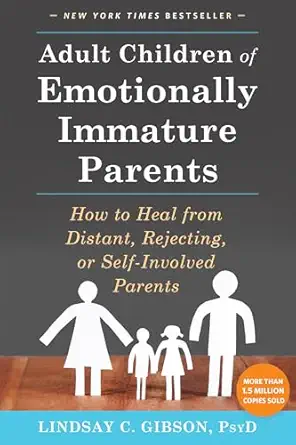
Lindsay Gibson, a clinical psychologist, wrote this for adults who grew up with parents who were emotionally unavailable, dismissive, or self-centered, even when the household looked functional from outside. She breaks emotionally immature parents into four recognizable types and explains the coping patterns their children tend to carry into adulthood, including chronic people-pleasing and a persistent sense of loneliness even in otherwise good relationships. Gibson leans on real case examples rather than dense jargon, keeping the book readable while staying clinically grounded. That combination is a big reason it keeps showing up in therapy recommendations for family-of-origin work. It’s grounded.
Availability:
In StockLindsay Gibson, a clinical psychologist, wrote this for adults who grew up with parents who were emotionally unavailable, dismissive, or self-centered, even when nothing about the household looked obviously dysfunctional from the outside looking in. She breaks emotionally immature parents down into four recognizable types, including the emotional parent who’s reactive and unpredictable and the rejecting parent who’s distant and withholding, and explains the specific coping patterns their children tend to carry forward into adult life. Those patterns often include chronic people-pleasing, difficulty trusting that relationships will hold up under conflict, and a persistent sense of loneliness even inside otherwise functional adult relationships. Gibson leans heavily on real case examples drawn from her decades of clinical practice rather than dense psychological jargon, which keeps the book readable for people without a therapy background while still feeling clinically grounded. She also addresses how to interact with emotionally immature parents now, as an adult, without either cutting them off entirely or continuing to absorb the same dynamics from childhood. That combination of validation and practical strategy is a big part of why it keeps showing up in therapy recommendations for people working through family-of-origin issues. It pairs naturally with other books on.

Reviews
There are no reviews yet.