
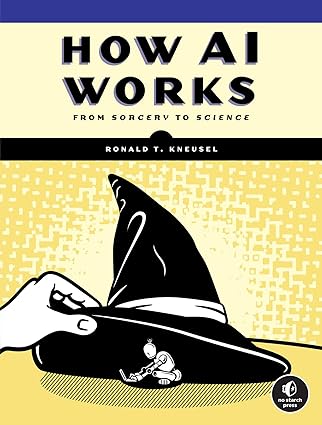
Ronald T. Kneusel demystifies artificial intelligence by pulling back the curtain on what AI systems actually do — not magic, not mystery, but specific mathematical and computational ideas that become surprisingly approachable in his hands. A compact, science-grounded introduction at 192 pages.
Availability:
In StockArtificial intelligence has accumulated a reputation for being either impossibly complex or vaguely magical, and How AI Works sets out to replace both impressions with something more accurate and more useful. Ronald T. Kneusel, who has a background in both scientific computing and machine learning, walks through the actual mechanisms behind AI systems — how neural networks learn from data, how computer vision systems interpret images, how language models generate text — with the goal of making each step genuinely understandable rather than hand-waving past the details with phrases like “the algorithm learns.” The subtitle, From Sorcery to Science, captures the book’s intent precisely: readers who start feeling like AI is mysterious should finish feeling like it’s comprehensible, built from specific ideas in mathematics and computation that, once explained clearly, are far less intimidating than they appeared from the outside. At 192 pages, the book stays deliberately compact, prioritizing conceptual clarity over exhaustive technical coverage, which makes it a realistic and accessible read for curious non-specialists rather than a dense resource for practitioners. For readers who’ve been surrounded by AI conversation and want to understand what’s actually happening inside these systems rather than taking the magic on faith, this offers one of the cleaner, more honest explanations available.
Author:
Ronald T. Kneusel
Reviews
There are no reviews yet.