
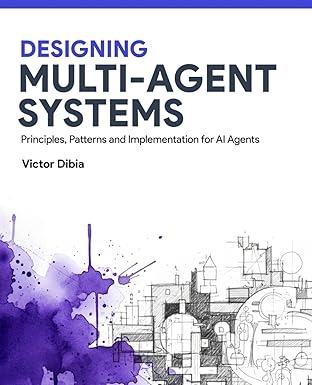
Victor Dibia narrows in on a specific, challenging problem within agentic AI: how do you design systems where multiple agents coordinate effectively rather than working at cross purposes? Designing Multi-Agent Systems covers the principles, patterns, and implementation details needed to build these systems well.
Availability:
In StockBuilding a single AI agent is hard enough; coordinating several of them, each potentially pursuing different subtasks, introduces an entirely new layer of complexity around communication, conflict resolution, and shared state. Designing Multi-Agent Systems tackles that complexity directly. Victor Dibia covers the architectural principles behind multi-agent coordination, the design patterns that have proven effective for managing communication between agents, and the practical implementation details engineers need to actually build these systems rather than just theorize about them. The book treats multi-agent design as a genuine engineering discipline, with real attention paid to failure modes — what happens when agents disagree, when coordination breaks down, or when one agent’s output needs to inform another’s next step. At 394 pages, it goes deep enough to be genuinely useful for engineers already working on agentic systems, rather than staying at a conceptual level. For anyone building systems where a single agent isn’t enough and real coordination between multiple agents is required, this addresses a specialized need that’s becoming increasingly relevant as agentic AI matures.
Author:
Victor Dibia
Reviews
There are no reviews yet.