
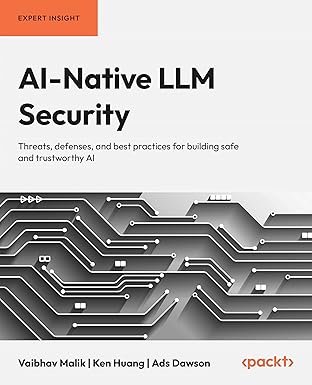
Vaibhav Malik, Ken Huang, and Ads Dawson focus specifically on LLM security, covering the threat landscape unique to large language model deployments and the defensive practices and architectural decisions that organizations need to build AI systems that can actually be trusted. This is a specialized, technically grounded resource for a genuinely emerging challenge.
Availability:
In StockLarge language models introduce a security surface that most existing frameworks weren’t built to address — prompt injection, jailbreaking, data leakage through model outputs, supply chain risks in foundation model dependencies, and the challenge of maintaining trust when model behavior can be difficult to audit or predict. AI-Native LLM Security is built specifically around these threats, rather than adapting general AI security principles that don’t always translate cleanly to LLM-specific deployments. Vaibhav Malik, Ken Huang, and Ads Dawson cover both the attack side — how LLMs can be exploited, manipulated, or made to behave in ways their deployers didn’t intend — and the defense side, including architectural patterns, input and output validation strategies, access control approaches, and monitoring practices suited to LLM environments. The term “AI-native” in the title reflects the book’s positioning: these are defenses designed from the ground up for LLM systems rather than retrofitted from older security paradigms. At 416 pages, the coverage is thorough enough to serve practitioners who need to make real security decisions about LLM deployments, rather than just raising awareness of the problem space. For security engineers and AI practitioners building systems on top of large language models and needing a grounded, implementation-level security reference, this fills a gap that’s still relatively underserved in the current literature.
Author:
Vaibhav Malik, Ken Huang, Ads Dawson


Reviews
There are no reviews yet.